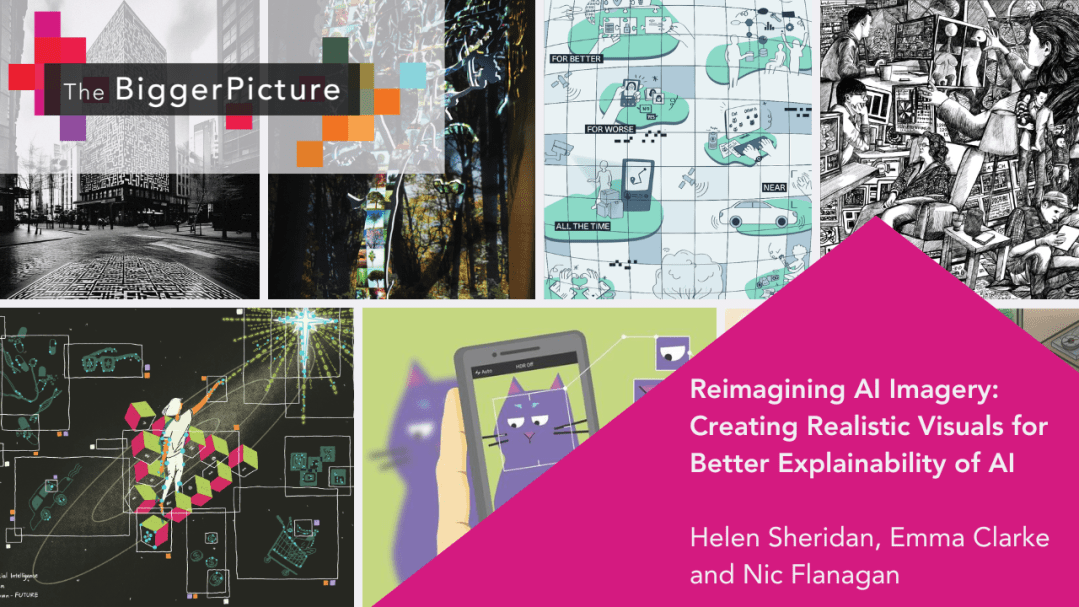
Helen Sheridan from ADAPT at TU Dublin will present “Reimagining AI Imagery: Creating Realistic Visuals for Better Explainability of AI” at the Education After the Algorithm conference which will be held at Dublin City University and online, February 20th-21st, 2025. This symposium, focused on critical AI and post-AI pedagogies, offers a vital space to discuss the future of education in the age of increasingly sophisticated algorithms.
The paper, co-authored with Emma Clarke (ADAPT, DCU) and Nic Flanagan (MTU), will outline work to date on “The Bigger Picture” an initiative that is addressing the often misleading imagery that dominates our understanding of AI technology. Think glowing brains, binary code, and anthropomorphic robots – these visuals do not accurately represent the true nature of AI. Rather, they reinforce misconceptions and hinder meaningful public discourse (Better Images of AI).
“The Bigger Picture” project uses a blend of participatory workshops, artist commissions, public exhibitions, this website and zines to engage communities in the creative process. A key element of “The Bigger Picture” workshops involves introducing fundamental Explainable AI (XAI) concepts. We explore how these concepts can be visually represented, making the often opaque workings of AI more transparent. Participants also engage in “uncoding” exercises to understand how prompting works in generative AI and create images reflecting their feelings about AI.
The “AI is Everywhere” call for submissions (2024) invited artists and image-makers to depict current AI realities, moving beyond dystopian or futuristic clichés. The resulting exhibition, held during Science Week 2024, showcased thought-provoking artwork that explored the integration of AI technology into daily life and the inherent humanity which underpins this technology. Selected submitted images were also added to the Better Images of AI online library, contributing to a broader effort to promote more realistic and diverse visual representations of AI.
At the Education After the Algorithm symposium, we’ll be sharing our experiences and insights from “The Bigger Picture” project and exploring how interdisciplinary collaboration can challenge dominant narratives about AI, while emboldening communities to engage critically with its impact on visual culture and society.
Sheridan, H., Flanagan, N., Clarke, E. (2025). Reimagining AI Imagery: Creating Realistic Visuals for Better Explainability of AI. Education After The Algorithm. Dublin. https://thebiggerpictureai.com/reimagining-ai-imagery-creating-realistic-visuals-for-better-explainability-of-ai/
References
Better Images of AI. (n.d.). Betterimagesofai.org. https://betterimagesofai.org/images
Dihal, K., & Duarte, T. (2023). Better images of AI: A guide for users and creators. Cambridge and London: The Leverhulme Centre for the Future of Intelligence and We and AI.
Call for Submissions: The Bigger Picture. (2024, October 21). The Research Ireland ADAPT Centre for AI-Driven Digital Content Technology. https://bit.ly/The-Bigger-Picture2024
Sheridan, H., Murphy, E., & O’Sullivan, D. (2024). Human centered approaches and taxonomies for explainable artificial intelligence. Conference papers, (427). Retrieved from https://arrow.tudublin.ie/scschcomcon/427
The Bigger Picture. (2024). The Bigger Picture. https://thebiggerpictureai.com/
Header Images
Reihaneh Golpayegani & The Bigger Picture / Better Images of AI / A Corner Of The History / CC-BY 4.0 (link)
Oleksandra Mukhachova & The Bigger Picture / Better Images of AI / Snapcat / CC-BY 4.0 (link)
Ariyana Ahmad & The Bigger Picture / Better Images of AI / AI is Everywhere / CC-BY 4.0 (link)
Yutong Liu & The Bigger Picture / Better Images of AI / AI is Everywhere / CC-BY 4.0 (link)
Elise Racine & The Bigger Picture / Better Images of AI / Glitch Binary Abyss I / CC-BY 4.0 (link)
Nico Crozier & The Bigger Picture / Better Images of AI / Seeing the Forest for the Trees / CC-BY 4.0 (link)
Joudy Bourghli & The Bigger Picture / Better Images of AI / The Omnipresent Tapestry / CC-BY 4.0 (link)
 The Bigger Picture